Die casting draft angles show up on your quote because they decide how easily a part releases from the die. Too little draft, or none at all, usually means extra die features such as slides, faster die wear, slower cycles, and secondary CNC machining to create walls that the die cannot form straight. Enough draft lets the part eject cleanly with less machining. Typical die casting draft angle guidance falls somewhere around 0.5° to 2° depending on alloy, wall depth, and whether the wall is inside or outside, but the right value depends on part geometry and should be confirmed on drawing review.
This article explains what draft is, why inside and outside walls need different amounts, and how engineers and buyers in California and across the U.S. can specify draft so a die casting quote reflects the real design.
What Is a Die Casting Draft Angle?
A draft angle is a slight taper on any wall that runs parallel to the direction the die opens. Instead of a perfectly vertical wall, the wall leans a fraction of a degree to a couple of degrees so the casting can slide off the die steel when it opens.
Without draft, the casting drags along the die surface during ejection. That causes scuffing, soldering (molten metal sticking to the die), distorted parts, and stuck castings that stop production.
Why Inside Walls Need More Draft Than Outside Walls
As molten metal solidifies, it shrinks. On outside walls, shrinkage pulls the casting away from the die cavity. On inside walls, such as cores, holes, and the inside of a housing, shrinkage pulls the casting tighter onto the die steel.
That is why die casting design guidelines generally call for more draft on inside walls than on outside walls. Deep cores and pockets need the most attention, because the longer the contact surface, the more grip the casting has on the steel.
Factors That Change the Draft Your Part Needs
Alloy
Zinc alloys generally release with less draft than aluminum alloys, and magnesium sits close to aluminum. If your drawing specifies one draft value for every wall, it may be more or less than the alloy actually needs.
Wall depth
Deeper walls generally need more draft. A shallow rib can release with a small taper, while a tall wall or deep core usually needs more.
Surface finish and texture
Textured or grained cosmetic surfaces grip the die more than smooth surfaces, so they typically need additional draft.
Critical fits
Some surfaces must be straight for a bearing, seal, or press fit. Those are usually cast with draft and then CNC machined straight, which is a common and cost-effective approach when it is planned from the start.
For detailed design guidance, buyers can consult the NADCA Product Specification Standards for Die Castings, which include draft recommendations by alloy and feature type, and then confirm values with the die casting engineering team for the specific part.
How Draft Angle Changes the Quote
When we review a drawing for die casting, draft affects cost in several concrete ways.
| Drawing condition | Likely effect on the quote |
|---|---|
| Adequate draft on all walls parallel to die opening | Simpler die, clean ejection, less machining |
| Zero draft on outside walls | May require slides or post-cast machining |
| Zero or minimal draft on deep cores | Higher die wear, ejection risk, more machining |
| Draft value not specified at all | Our engineering team proposes draft; quote notes assumptions |
| Straight walls needed only on a few fit surfaces | Cast with draft, then machine those surfaces only |
Tooling cost
Walls that cannot have draft sometimes need slides or moving cores in the die. Each one adds die complexity, maintenance, and tooling cost.
Cycle time and die life
Parts with too little draft stick harder, so ejection is slower and the die surfaces wear faster. Over a production program, that affects cost per part.
Secondary machining
If a wall must end up straight, the usual route is to cast it with draft and machine it afterward. Each machined surface adds an operation, fixturing, and inspection, so limiting straight-wall requirements to true fit surfaces keeps the quote lower.
Scrap and cosmetic issues
Insufficient draft increases the chance of drag marks, cracks, and distortion during ejection. On cosmetic parts, that can mean more sorting or rework.
How to Specify Draft on Your Drawing
- Add a general draft note. For example, state a default draft for outside and inside walls, with exceptions called out.
- Mark the die opening direction if it is not obvious from the views, or invite our team to propose it.
- Identify surfaces that must be straight and accept that they will be machined after casting.
- State whether dimensions apply at the top or bottom of the draft (or at the midpoint), so the tolerance is unambiguous.
- Note texture or cosmetic requirements, since they change the draft needed.
- Share a 3D model where possible, so draft can be checked on every wall instead of only the views shown.
Reviewing Draft With Our Engineering Team
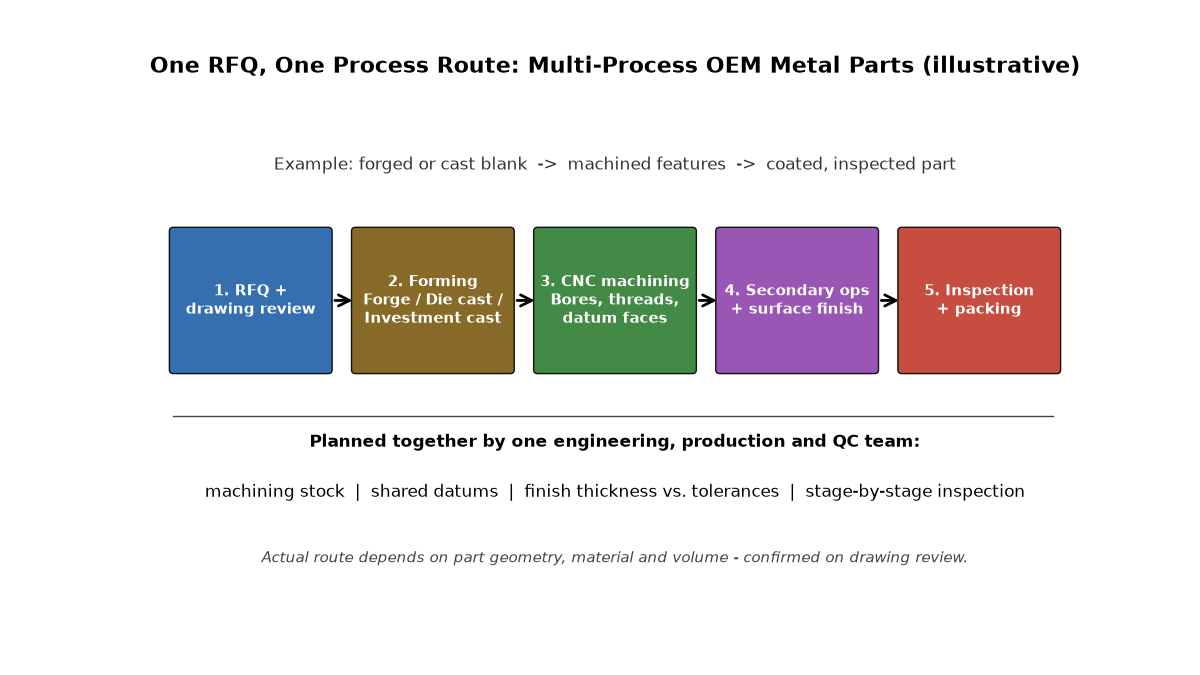
At Manufacturing Standard, our engineering team reviews draft, parting line, and ejection together when quoting die casting parts, and plans any CNC machining of straight-wall features in the same program. If a drawing has zero-draft walls, we point out which ones can take draft and which truly need machining, so the quote reflects a design the die can produce reliably. Buyers in San Diego and Southern California can also reach our office in Poway, CA. Send your drawing and 3D model through the RFQ page.
FAQ
What is a typical die casting draft angle?
General guidance often falls roughly between 0.5° and 2°, with inside walls needing more than outside walls and zinc needing less than aluminum. The right value depends on alloy, wall depth, and texture, and should be confirmed on drawing review.
Can a die-cast part have zero draft?
Some features can be cast with very little draft, but zero-draft walls usually require slides or post-cast machining. Most designs cast the wall with draft and machine only the surfaces that must be straight.
Why do cores need more draft than outside walls?
The casting shrinks as it cools. That pulls it away from outside walls but tighter onto cores and inside walls, so inside features need more taper to release.
Does draft affect dimensional tolerances?
Yes. Because a drafted wall changes size along its depth, the drawing should state where a dimension applies, such as at the parting line or the base of the wall.
Where can I find die casting draft guidelines?
The NADCA Product Specification Standards for Die Castings is a widely used reference. Final draft values should be agreed with the engineering team reviewing your specific part.
Have a part to quote?
Send us your drawings and requirements and our team will review your RFQ.